Steeped in history and located right beside the ancient Feroz Shah Kotla fort, the Arun Jaitley Stadium in New Delhi is the second-oldest functional cricket stadium in India. The venue blends old Delhi heritage with modern cricketing energy.
As of early 2026, the stadium has undergone significant upgrades to host matches of the ICC Men’s T20 World Cup. Known for its towering vertical stands and its red-soil pitch, it remains the core of Delhi’s cricket identity.
1. Stadium Layout and Architecture
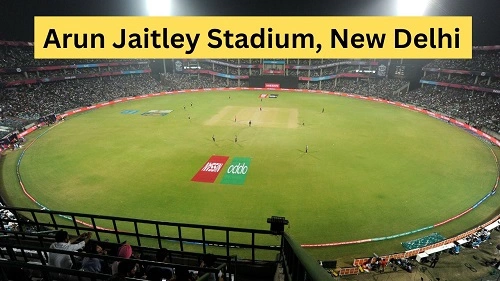
The layout of Arun Jaitley Stadium is shaped by its location. Unlike the massive open ovals seen in newer cities, this ground sits in a dense urban pocket. Space is limited. So instead of expanding outward, it rises upward.
The result is a compact bowl with tall, multi-tiered stands. Spectators sit close to the boundary ropes. The closeness creates intensity. Even a crowd of 35,000 can sound much bigger here.
Iconic Stands
The stadium celebrates Delhi cricket legends through its named sections:
1. Virat Kohli Pavilion
Situated at the Pavilion End, this is the most prestigious stand. It carries the name of Delhi’s most famous modern cricketer.
2. Bishan Singh Bedi Stand
Located at the Hill End, named after the legendary left-arm spinner.
3. Mohinder Amarnath Stand
Honors the hero of India’s 1983 World Cup campaign.
4. Gautam Gambhir Stand
Dedicated to the two-time World Cup winner who played crucial knocks in 2007 and 2011 finals.
5. Raman Lamba & Prakash Bhandari Dressing Rooms
Named in memory of figures closely linked with Delhi cricket’s history.
The vertical structure gives almost every seat a direct view of the field. There are no massive empty spaces. It feels tight, loud, and personal.
2. Arun Jaitley Stadium Capacity
The stadium’s seating capacity has seen minor adjustments due to recent renovations and VIP box upgrades.
As of the 2026 T20 World Cup, the official capacity stands between 35,000 and 41,000, depending on configuration and match setup.
There have been ongoing discussions by the DDCA about building a new 70,000-capacity stadium in areas like Dwarka or Okhla. But for now, the Arun Jaitley Stadium focuses on maximizing its historic footprint through high-density, vertical seating.
The compact nature is actually part of its charm. The noise stays inside. Pressure builds quickly during tense chases.
3. Gates and Entry Points
Security is tightly managed through multiple numbered gates along Bahadur Shah Zafar Marg.
Gate No. 1
Primarily reserved for VIPs, players, and media personnel.
Gate Nos. 10–15
These serve the eastern side and are commonly used by general public ticket holders.
Special Entry Upgrades
Between 2024 and 2025, several entry points were upgraded with digital ticket scanning systems to manage large crowds efficiently for the 2026 World Cup.
4. Arun Jaitley Stadium Nearest Metro Connectivity
One of the stadium’s biggest advantages is public transport access. Delhi Gate Metro Station (Violet Line) is just a two-minute walk from the stadium entrance. On match days, most fans prefer the metro due to heavy traffic and limited parking.
5. Modern Facilities
In preparation for the 2026 season, the Delhi & District Cricket Association (DDCA) carried out several key improvements.
Vertical Circulation
Because of the stadium’s tall structure, new electric lifts have been installed for general stands. This helps elderly fans and differently-abled spectators reach upper tiers more comfortably.
VIP Hospitality
New steel-structure VIP boxes were completed in late 2025. The upgraded “Kotla Lounges” now feature air-conditioned seating, catering services, and improved viewing angles.
P.A. System
A modern one-to-one channel public address system was installed ahead of the 2026 World Cup. It improves sound clarity for announcements, music, and entertainment segments.
Back-End Utilities
Dressing rooms, umpire areas, and physiotherapy centers were fully modernized to meet ICC Elite standards. Recovery zones and player facilities now match international expectations.
6. The Pitch and Playing Conditions
The red-soil surface at Arun Jaitley Stadium is known for producing high-scoring games, especially in T20 cricket. The ball tends to come nicely onto the bat.
However, as matches progress, the pitch can slow down. Spinners often play a key role during middle overs. In shorter formats, totals above 180 are common.
Because of the smaller boundary dimensions compared to some larger stadiums, six-hitting becomes a major feature of games here.
7. Ticket Pricing
Ticket prices in Delhi remain competitive, especially for IPL matches featuring Delhi Capitals and for T20 World Cup fixtures.
Here’s a general pricing overview for 2026:
T20 World Cup (Group Stage)
- Entry-Level: ₹100
- Premium/Pavilion: ₹12,000+
IPL 2026 (Delhi Capitals Home Matches)
- Starting Price: ₹750
- Premium Sections: ₹18,000+
International Test / ODI Matches
- Starting Price: ₹500
- Premium: ₹7,500 – ₹10,000
High-profile matches can see resale prices increase sharply, particularly in the Virat Kohli Pavilion and corporate boxes.
Tickets are usually sold through official online platforms. Early booking is strongly advised for major games.
Conclusion
Arun Jaitley Stadium may not have the sweeping architecture of newer mega-arenas, but what it offers is character. Its vertical stands, historic setting beside the Kotla fort, and charged atmosphere make it one of India’s most distinctive cricket venues.
It is compact. It is loud. It is deeply connected to Delhi’s cricket legacy.
Whether it’s a high-scoring IPL thriller or a tense World Cup clash, the experience here feels immediate and intense. For Delhi fans, this ground is more than a stadium. It is home.